In Umnugobi Aimag, there are four mountains. King Mountain (Noyon uul), Queen Mountain (Khatan uul), Prince Mountain (Khuu uul) and a mountain named after the member of court that assists the King, his servant, and organises the King's domain. In Mongolian this person is known as the Tushmel and so that mountain is called Tushmel uul. Noyon uul is near Noyon Soum in that Aimag. One day, a long time ago, the mountains were close. Noyon uul and Khatan uul then argued and fought. They argued so hard that Noyon uul decided to move to the east whilst Khatan uul moved to the west. As part of this argument, Khatan uul, the Queen Mountain, kicked a rock mirror at Noyon uul, the King Mountain. Noyon uul kicked a table in his anger.
So now in Noyon Soum we find Khatan uul to the north west and Noyon uul to the south east. In front of Khatan uul is a mountain range that looks like a line of soldiers, protecting the queen. Khuu uul and I are behind Noyon uul, with the table rock between them and Noyon uul.
The mirror rock that the Queen Mountain threw was of a dark polished stone, When you looked on one side of it, you could see Khatan uul reflected in it. Look in the other side and you could see Noyon uul reflected in it. It was a beautiful rock.
In 1932 the Russians came into this area and shot the Mirror Rock. No one is quite sure why, other than it was perhaps because the rock was beautiful. The result of this vandalism was that now the rock is destroyed.
Noyon uul was so named as the rocks on the top of this mountain resemble the type of cap that the old rulers of Mongolia wore. Visitors can still travel to Noyon uul, Khatan uul, Khuu uul and Tushmel uul and see the remains of the mirror rock.
Umnugobi Aimag is the southern most Aimag in Mongolia and borders with China. It is fairly easy to reach from Ulaanbaatar.
Wednesday, 31 August 2005

Tuesday, 30 August 2005
Airag
 Airag is fermented horse's milk. It is a favoured drink amongst Mongolians during the summer months. Whenever we drive out of town now we check the quality of the Airag at the local herder's ger.
Mind you, there is some custom involved in the drinking of Airag. The most interesting thing relates to the first drink of Airag of the season. Now, it should be noted that Airag is served in a large tumbler type glass or big bowl and it is usual to finish the whole glass in one go. So, you down a glass of Airag and wait. If after a period of time you feel like urinating (Number One's) then you are OK. If, however, it is Number Two's that strike and in a, shall we say, fairly wet manner, then you are not ready for drinking Airag this season.
I did Number One's.
Now, "how does it taste?" I hear you ask. Well, let me put it this way. You know how horses have a particularly, well, horsey smell, and how everything related to horses ends up smelling the same way? Airag is no different. It tastes of horse smell. Having said that, it is a fairly smooth drop (it is only fermented milk after all) and flows down really rather easily. After downing a glass of Airag you are left with a creamy taste in the mouth.
It is fun watching the family empty every container in the car so that they can collect some more Airag.
If you are travelling Mongolia, make sure you try the Airag ... but do remember to stop after the first drink to see whether you will be struck with Number One's or Number Two's :-)
Friday, 26 August 2005
Horse Poo
 and cow poo, and yak poo. Living out on the Steppe, where there are no fences, are many horses, cows, yaks, sheep and goats. Now horses, cows and yaks in particular leave sizeable poos. Mongolia is generally a fairly dry country so these pads dry out very quickly and form a good source of fire fuel. When my favourite Mongolian family travels to the countryside and needs to make a fire to cook, fuel is collected. First thing collected is wood. The wood, however, must be laying on the ground to be used, otherwise it is left. Also collected is dried Poo. In the picture you can see Tseye, plastic bag in hand, collecting poo for the fire whilst the rest of us pitch tents (well, except Thomo who was taking the picture of course).
The poo works really well as a fuel, generating a lot of heat. A few twigs, some dried poo and a match and the fire is started. Add some river rocks in there, wait, then add the rocks to the pot along with meat, potatoes and carrots and hey presto, Khorkhog :-)
Thursday, 25 August 2005
Cave of the Yellow Dog
We like the cinema here. It is run by a Korean company and the entry fee is 3,000 tugrigs each (about US $2.50). Toss another 2,000 tugrigs down for popcorn and drink and the movies become an inexpensive night out.We had seen "The Tale of the Weeping Camel" so Tseye decided that we should see the "Cave of the Yellow Dog". Byambasuren Davaa wrote the screenplay to this as well as directing the movie. It is set in the countryside of Mongolia and is based around a herder's family. The family is a real family, rather than actors, and they give a wonderful idea of what is like for a herder and his family.
The story is set around the family's eldest daughter. She comes back from school early in the summer (herder's children are generally boarded away at school during teaching time, coming back to the family during the school holidays). When looking after the family's flock of sheep and goats she finds a dog.
Her father is worried about the dog though as they do not know where the dog is from, just that the dog was found in a cave and is therefore more likely to have wolf exposure. The father worries about the dog bringing the family bad luck. Indeed, it seems this may be the case although in the end the dog proves his worth.
A recommended movie this, doubly so as it really does give a good idea of life in a herder's family in Mongolia. Note that the photo attached to this is not from the movie, but is a genuine herder's hut.
The story is set around the family's eldest daughter. She comes back from school early in the summer (herder's children are generally boarded away at school during teaching time, coming back to the family during the school holidays). When looking after the family's flock of sheep and goats she finds a dog.
Her father is worried about the dog though as they do not know where the dog is from, just that the dog was found in a cave and is therefore more likely to have wolf exposure. The father worries about the dog bringing the family bad luck. Indeed, it seems this may be the case although in the end the dog proves his worth.
A recommended movie this, doubly so as it really does give a good idea of life in a herder's family in Mongolia. Note that the photo attached to this is not from the movie, but is a genuine herder's hut.
Tuesday, 23 August 2005
Mongolian Barbeque?? No, Khorkhog
[caption id="" align="alignleft" width="400" caption="The rocks, meat, potato and carrots are added to the pot"] [/caption]
I have to admit, before coming to Mongolia I really had no idea of the style of cooking and food used in Mongolia. I mean, I had eaten Mongolian Lamb at the local Chinese Restaurant, I had eaten Shabu Shabu at other places and of course, I had heard of Mongolian barbeque, barbequing on hot rocks. Well, I have to say that generally the Mongolians are a patient people so will wait for lambs to grow up and become sheep (mutton), I have never seen anything resembling Shabu Shabu and the only barbeque I have seen in Mongolia is at BDs Mongolian Barbeque Restaurant which is, of course, an American chain. As a barbeque is an outside meal in Australia (and one cooked traditionally by men), I decided to recount the local equivalent. This is Khorkhog (pronounced like "horhog") and is where river stones are heated in a fire and then added to the cooking pot along with mutton meat, potatoes (OK, so this is only a 500 year old traditional Mongolian Meal as potatoes of course were not known in this part of the world until only a few hundred years ago) and carrots.
The food is layered with a little water, hot rocks and salt and built to the top of the pot. The pot itself ideally should be airtight (and yes, I am wondering how traditional an airtight pot can be). In the case of my favourite Mongolian Family, a pressure cooker is used. The handles of the cooker are wrapped in wet rags to protect them from the later flames and heat. So, place some rocks from the fire, then meat, potato, carrots and a little salt. Add some more rocks and repeat the food layer. Keep doing this until the pot is full. Put the top back on and then place the pot back in the fire. Leave for about 30 minutes to an hour (no real rush here).
When the stuff in the pot is cooked, remove from fire, open carefully and serve. The liquid is put into a cup and passed around as a sort of really rich soup. The meat, potatoes and carrots are just so tasty. Eat with some pickles and wash down with ones favourite libation. Heaven.
[/caption]I have to admit, before coming to Mongolia I really had no idea of the style of cooking and food used in Mongolia. I mean, I had eaten Mongolian Lamb at the local Chinese Restaurant, I had eaten Shabu Shabu at other places and of course, I had heard of Mongolian barbeque, barbequing on hot rocks. Well, I have to say that generally the Mongolians are a patient people so will wait for lambs to grow up and become sheep (mutton), I have never seen anything resembling Shabu Shabu and the only barbeque I have seen in Mongolia is at BDs Mongolian Barbeque Restaurant which is, of course, an American chain. As a barbeque is an outside meal in Australia (and one cooked traditionally by men), I decided to recount the local equivalent. This is Khorkhog (pronounced like "horhog") and is where river stones are heated in a fire and then added to the cooking pot along with mutton meat, potatoes (OK, so this is only a 500 year old traditional Mongolian Meal as potatoes of course were not known in this part of the world until only a few hundred years ago) and carrots.
The food is layered with a little water, hot rocks and salt and built to the top of the pot. The pot itself ideally should be airtight (and yes, I am wondering how traditional an airtight pot can be). In the case of my favourite Mongolian Family, a pressure cooker is used. The handles of the cooker are wrapped in wet rags to protect them from the later flames and heat. So, place some rocks from the fire, then meat, potato, carrots and a little salt. Add some more rocks and repeat the food layer. Keep doing this until the pot is full. Put the top back on and then place the pot back in the fire. Leave for about 30 minutes to an hour (no real rush here).
When the stuff in the pot is cooked, remove from fire, open carefully and serve. The liquid is put into a cup and passed around as a sort of really rich soup. The meat, potatoes and carrots are just so tasty. Eat with some pickles and wash down with ones favourite libation. Heaven.
Sunday, 21 August 2005
Best Cheeseburger in Ulaanbaatar
Being a gentleman of, shall we say, more fulsome figure, eating seems to have been a prominent part of my life. Travelling a lot has meant many meals in hotels. Business has resulted in even more restaurant meals. After a while, though, what Thomo really craves is simple food, the sort of stuff you'd cook at home. Be that a humble chicken sandwich or just a bowl of soup and fresh bread. Travelling can get tiring food-wise after a time. By the time you've got to your third Duck l'Orange or Pheasant Under Glass it is all starting to taste the same.
To counteract the Michelin Star Blues, I generally ensure that I try a cheeseburger in every country I travel to (along with the search for the perfect cappuccino of course). So far, the best I have encountered in Ulaanbaatar are at:
Mongolia does not have any McDonald's, Burger Kings or the like, so there is no problem defining a good cheeseburger here.
To counteract the Michelin Star Blues, I generally ensure that I try a cheeseburger in every country I travel to (along with the search for the perfect cappuccino of course). So far, the best I have encountered in Ulaanbaatar are at:
- California - A US style restaurant and bar on Seoul Street. The cheeseburgers here have a combination of quality (good meet, cheese and supplementary items) as well as quantity (recommendation is to start eating the cheeseburger first then come back to the chips).
- Dave's Place - Where the beer is, of course, X-cellent. Dave does a quite reasonable cheeseburger too.
- Millies - Smaller that California's (and also a little cheaper too for that matter), Millies' cheeseburgers are a good lunch from time to time.
Mongolia does not have any McDonald's, Burger Kings or the like, so there is no problem defining a good cheeseburger here.
Thursday, 18 August 2005
When the Trucks Stop

 Puujee (father of my favourite Mongolian family) noted to me that he thought the reason that the truck driver had attempted to cross the Tuul gol (Tuul River) there rather than using that rickety bridge was not for fear of the bridge falling, but rather a desire to get to the other side of the Tuul gol as quickly as possible to sit and drink vodka. So, as you can see, we have some heavy machinery to move the truck and at the same time, the foreman is there as well, supervising the process.
In the meantime, folks are still fishing from the bridge.
Tuul Gol Bridge
 We had gone here once before. Unfortunately, the first time we came here, I did not have my digital camera with me. We were trying to decide where to go last Sunday and my favourite Mongolian family suggested coming back to here as I had mentioned wanting to photgraph the bridge. They also noted that as summer was rapidly departing, it would be better to do it now whilst the weather was still OK.
So, we went out there again and I managed to get stung by nettles (Khalgai) - as well as getting terribly drunk on vodka. Must suggest to famly that vodka is perhaps not the best drink for Thomo on picnics.
There is a picture of the bridge with this blog. Yes, it looks that dilapidated in real life. We have driven across the bridge twice and I have walked over it now - it is as rickety as it looks and the whole bridge shakes and wobbles when vehicles drive over it.
I will do a separate website, perhaps elsewhere in Thomo's Hole Proper, devoted to the bridges of Mongolia. Having seen a couple now I shall keep photographing them.
Wednesday, 17 August 2005
What's It To Feel Mongolian
I must admit, I have wondered when travelling in the countryside with my favourite Mongolian family, why the expressions on their faces change as soon as they reach the Ulaanbaatar city limits. I noticed the same thing with the guys who came on the whirlwhind four Aimag tour with me earlier this year. Also, every chance they get in the summer, the family is out to the countryside. I then received a lovely email or two from a Mongolian lady living in the US. She gave me permission to reprint the content of it here. It seems to sum up what it is to be a Mongolian and why Mongolians of all people seem to have the greatest difficulty living outside of Mongolia. Alimaa noted:
"Sain, sain bain uu?
"I am glad that you are one of the foreigners who love Ulaanbaatar (UB). Though I have to admit that if I were not born and raised in UB I am not sure if I would love UB. But again UB today is not UB in a lot of senses the UB I know or the UB I grew up in. I can understand and identify lots better with people falling in love with the countryside of Mongolia. That fenceless land under the eternal blue sky that I can claim as all mine. And that is the feeling that I would never be able to replicate, alas.
"In summer of 1993, I remember at some point there were four us on a weekend hitch-hiking trip from Kharkhorin after visiting the ancient capital of the Mongolian mighty empire back to UB and it happened so that our little hike coincided with the election weekend, which meant that there were no cars going from or back to UB.
"We walked for two whole days and I remember there were sea of rolling hills all around us, not another human being in sight as far as one's eye could see and that is when I remember having that feeling of vastness, continutiy, and eternity and the feeling of owning this whole land all to myself. This land was granted, handed down to me from my fore and fore grandmothers and grandfathers. This land was mine, this sky was mine, those rolling hills were mine.
"Now that was freedom, freedom to own, freedom to love and freedom to go wherever our souls pleased to. And we had no tents, no sleeping bags, no food rations with us, we were just at the mercy of Mongol nomads' hospitality, that is if we ever happened to cross one. And of course we did, and of course we were fed well and put to sleep in some herders' warm ger.
"Now fastforward 12 years later, here I am writing an email message from my home in Northern Virginia at 2am in the morning to Mongolia!
"Speaking of Mongolia, I did visit Mongolia in the last 12 years. Three times to be exact. But you know how these visits go - short, restless, too many people in too little time, almost superficial, though. Never get to see and observe the real flow of life and struggles and beauty of the county life.
"The last time I visited UB and Mongolia was in 2001. I am hoping maybe next summer I could stay for a nice extended visit .... will have to see.
"Cheers,
"Alimaa"
And I think that about covers what it feels like to be a Mongolian in the countryside of Mongolia. Alimaa is also very articulate (as you can see) and I would hope that I can persuade to write some more, in English, about being a Mongolian abroad, or growing up in Ulaanbaatar. I will happily publish what she writes here.
"Sain, sain bain uu?
"I am glad that you are one of the foreigners who love Ulaanbaatar (UB). Though I have to admit that if I were not born and raised in UB I am not sure if I would love UB. But again UB today is not UB in a lot of senses the UB I know or the UB I grew up in. I can understand and identify lots better with people falling in love with the countryside of Mongolia. That fenceless land under the eternal blue sky that I can claim as all mine. And that is the feeling that I would never be able to replicate, alas.
"In summer of 1993, I remember at some point there were four us on a weekend hitch-hiking trip from Kharkhorin after visiting the ancient capital of the Mongolian mighty empire back to UB and it happened so that our little hike coincided with the election weekend, which meant that there were no cars going from or back to UB.
"We walked for two whole days and I remember there were sea of rolling hills all around us, not another human being in sight as far as one's eye could see and that is when I remember having that feeling of vastness, continutiy, and eternity and the feeling of owning this whole land all to myself. This land was granted, handed down to me from my fore and fore grandmothers and grandfathers. This land was mine, this sky was mine, those rolling hills were mine.
"Now that was freedom, freedom to own, freedom to love and freedom to go wherever our souls pleased to. And we had no tents, no sleeping bags, no food rations with us, we were just at the mercy of Mongol nomads' hospitality, that is if we ever happened to cross one. And of course we did, and of course we were fed well and put to sleep in some herders' warm ger.
"Now fastforward 12 years later, here I am writing an email message from my home in Northern Virginia at 2am in the morning to Mongolia!
"Speaking of Mongolia, I did visit Mongolia in the last 12 years. Three times to be exact. But you know how these visits go - short, restless, too many people in too little time, almost superficial, though. Never get to see and observe the real flow of life and struggles and beauty of the county life.
"The last time I visited UB and Mongolia was in 2001. I am hoping maybe next summer I could stay for a nice extended visit .... will have to see.
"Cheers,
"Alimaa"
And I think that about covers what it feels like to be a Mongolian in the countryside of Mongolia. Alimaa is also very articulate (as you can see) and I would hope that I can persuade to write some more, in English, about being a Mongolian abroad, or growing up in Ulaanbaatar. I will happily publish what she writes here.
Stinging Nettles

 There I was, in shorts and thongs (flip flops for the English). Taking photographs of the bridge over the Tuul gol (Tuul River) outside of Ulaanbaatar when as chance would have it, I stepped through a small plant. Hmm, thinks Thomo, there is something hot and itchy on my left leg. I naturally then rubbed the left leg with the right leg. Damn, hot and itchy on both legs now. I photographed the plant, photographed the bridge and then came back to the car. I showed my favourite Mongolian Family the picture of the plant on the digital camera and they all laughed. Thomo had stumbled through a patch of stinging nettles. In Mongolian, these are called khalgai (thank you for that name Alimaa).
I can report, however, that standing in the cold, fast moving waters of the Tuul gol relieved the stinging feeling from my legs. Er, the beer helped as well ;-)
Monday, 15 August 2005
The Praying Man

 Near Terelj National Park is a rock formation known as the Praying Man. When driving from Ulaanbaatar to Terelj, if you are lucky you can make out the rocks that form the Praying Man. However, it is travelling from Terelj back to Ulaanbaatar that the praying man is most visible.There are many rock formations across Mongolia that look like other things, this is one of them.
Terelj National Park (Protected Area)
 There is a lovely area about 50 minutes drive or so from Ulaanbaatar. Taking the South Road and heading south out of town and then turning off to Terelj. Once you enter the areas you travel past some lovely terrain, a mix of rocks, mountains, hills, valleys and all manner of stuff. Some of the rock formations make quite visible objects (look out for these described later here).
What is really nice in this area (and indeed, in many other areas of Mongolia) is how much like Mongolia this area does NOT look like. I mean, ask 10 people what they think Mongolia looks like and they'll tell you "flat, desert, steppe, windy, no trees". It is not surprising that those images abound as those flat featureless areas have a mystery in and off themselves and as such, they are what captures the imagination of people outside Mongolia ... dreaming of Chinggis' Hordes, white flag to the fore, riding across the Steppe to conquer most of the known world.
The truth about Mongolia is somewhat different. Yes, there are those flat steppe areas. Yes. the Gobi is a desert. And yes, the steppe and the desert cover a large area of the country. There are, however, also mountains, lakes, trees and such spread across the country as well. Mongolia is generally, flat in the south, mountainous in the north.
 My favourite Mongolian family knows I really like trees (see an earlier blog here about Dancing Trees and Pretty Girls - in the June 2005 archives) so they tend to take me to places that are tree filled. Terelj is one such area. There are tourist camps in the Terelj area so visitors can stay there a couple of days. There is also a Korean restaurant, lots of gers (many selling Airag), horses, some camels and yaks, pretty much most things people want to see when they come to Mongolia. There is also a lovely park area.
We stopped there, we had lunch (salami, cheese, bread and beer) and then we had dinner (mutton, potatoes, carrots, er, and beer). Look closely at the pictures. Does this look like the Mongolia you imagine? Come have a look at the country.
Poor Cappuccino Froth and Coffee Not Quite Hot
One thing that Thomo has continually searched the world for is the perfect cappuccino. I've travelled to around 50 countries and have tried a cappuccino in most of them - even in Cambodia. For the record, the best one so far, allowing for the temperature of the coffee and the thickness of the froth, was the Italian Restaurant on the Aker Brygge in Oslo, Norway. That coffee was absolutely magnificent. The fact that it was summer and there were loads of gorgeous Norwegian girls walking past as we drank it only served to heighten the experience. I digress however.
Ulaanbaatar has a number of foreign restaurants - French, Italian, Korean and so on. It also has a number of coffee shops (German, French, Italian and Korean) selling coffee and pastries. I have tried a "cap" in most of them and so far they have all come up short. The coffee component is lukewarm or the froth is thin. It just was never quite right.
I did start to wonder if the problem was the milk here. Some of the milk is local and the rest of it appears to be imported from Korea. Then it occurred to me. Baagi (Baggy), my translator and ever faithful aide confidente and I were talkiing whilst driving home. We were talking about the boiling point of water and how it gets lower the higher you get (go on, cast your mind back to high school physics).
Then it occurred to me - perhaps temperature is the problem. Ulaanbaatar is 1316 metres above sea level. That means that water boils here at 95 degrees celsius, not 100 as it does in say Sydney. Cappuccine requires steam passing through milk and steam occurs when water boils. In Ulaanbaatar, the steam is cooler than in low laying cities. Could this be the reason I could not find a good cappuccino in Ulaanbaatar? Perhaps.
In any case, I am glad to report that I have found the best cappuccino in Ulaanbaatar. It is at the newly opened Irish pub, the Grandkhaan. They have a coffee corner and the cappuccino there is really very good.
Ulaanbaatar has a number of foreign restaurants - French, Italian, Korean and so on. It also has a number of coffee shops (German, French, Italian and Korean) selling coffee and pastries. I have tried a "cap" in most of them and so far they have all come up short. The coffee component is lukewarm or the froth is thin. It just was never quite right.
I did start to wonder if the problem was the milk here. Some of the milk is local and the rest of it appears to be imported from Korea. Then it occurred to me. Baagi (Baggy), my translator and ever faithful aide confidente and I were talkiing whilst driving home. We were talking about the boiling point of water and how it gets lower the higher you get (go on, cast your mind back to high school physics).
Then it occurred to me - perhaps temperature is the problem. Ulaanbaatar is 1316 metres above sea level. That means that water boils here at 95 degrees celsius, not 100 as it does in say Sydney. Cappuccine requires steam passing through milk and steam occurs when water boils. In Ulaanbaatar, the steam is cooler than in low laying cities. Could this be the reason I could not find a good cappuccino in Ulaanbaatar? Perhaps.
In any case, I am glad to report that I have found the best cappuccino in Ulaanbaatar. It is at the newly opened Irish pub, the Grandkhaan. They have a coffee corner and the cappuccino there is really very good.
Sunday, 14 August 2005
Entrance Charges for Foreigners
Yesterday we drove out to Terelj. Terelj is a protected area (I guess it is the equivalent of a National Park). There are Juulchin (tourist) camps and the usual horse and camel rides available. There is also some lovely quiet places, near the river and so on. As you approach Terelj, there is an entrance gate manned by government employees - at lease I guess that is who employs them. They collect an entrance fee for the park. The charge is 300 tugrig for a Mongolian or 3000 tugrig for a foreigner. This does, of course, annoy many foreigners, especially those that come from countries where we have been taught to protect the local environment and especially the environment within a National Park.
However, the twin charging scheme applies almost everywhere in Mongolia. At the Gandantegchinlen Khiid monastery with 25 meters high statue of Migjid Janraisig in Ulaanbaatar, Mongolians are let in for free but non Mongolians are charged $1.00. I believe that if you were a foreigner and are now a permanent resident in Mongolia, or citizen, you still have to pay the foreigner rate. That, I think, is a little unfair. I can accept the higher rate for bona fide foreign tourists and businessmen here temporarily over locals, if only because the minimum wage set by the government in Ulaanbaatar is currently $37 per month, whereas $37 is perhaps about the same amount a pair of tourists may have spent for dinner the last night. Charging locals 3,000 tugrigs would therefore be the equivalent of charging them a fair percentage of their monthly income.
Still, it is sometimes galling to have to pay the two fees, especially when it is my favourite Mongolian family taking me out. Yesterday we avoided the problem. As we approached the gate, I was asked to get something from the back of the vehicle. The fees were paid with the gatekeeper able to see the three Mongolians in the vehicle as well as my bottom. As we pulled off I was told to look forward so that the gatekeeper would not see me as we drove past.
Success, Thomo in for 300 tugrigs. Still, I guess the truly amazing part of this story is that Thomo must have a very Mongolian looking bottom ;-)
However, the twin charging scheme applies almost everywhere in Mongolia. At the Gandantegchinlen Khiid monastery with 25 meters high statue of Migjid Janraisig in Ulaanbaatar, Mongolians are let in for free but non Mongolians are charged $1.00. I believe that if you were a foreigner and are now a permanent resident in Mongolia, or citizen, you still have to pay the foreigner rate. That, I think, is a little unfair. I can accept the higher rate for bona fide foreign tourists and businessmen here temporarily over locals, if only because the minimum wage set by the government in Ulaanbaatar is currently $37 per month, whereas $37 is perhaps about the same amount a pair of tourists may have spent for dinner the last night. Charging locals 3,000 tugrigs would therefore be the equivalent of charging them a fair percentage of their monthly income.
Still, it is sometimes galling to have to pay the two fees, especially when it is my favourite Mongolian family taking me out. Yesterday we avoided the problem. As we approached the gate, I was asked to get something from the back of the vehicle. The fees were paid with the gatekeeper able to see the three Mongolians in the vehicle as well as my bottom. As we pulled off I was told to look forward so that the gatekeeper would not see me as we drove past.
Success, Thomo in for 300 tugrigs. Still, I guess the truly amazing part of this story is that Thomo must have a very Mongolian looking bottom ;-)
Fences
 Fences are a reasonably new phenomenon in Mongolia. Most of the country is unfenced and the herders live a nomadic lifestyle. Even near the Aimag Centres and the Soums and Bags there are no fences. However, this changes when you get into the Soums, Aimag Centres and such, with fences now enclosing parcels of land that Mongolians now own. The rest of the country is still unowned (I guess this means that the government owns it) and people and animals roam as they will.
The Soums and Aimag Centres are becoming more like everywhere else in the world now with property fenced.
Talking about A Shower, My Kingdom For A Shower
Today Hot Water! Oh heaven, oh bliss. I feel squeaky clean at last. 10 days in total it was off :-(Quote
Talking about Talking about A Shower, My Kingdom For A Shower
August 12 and still no hot water. Now I am really hanging out for a shower, a nice hot shower. A couple of days ago, I was ready to slip around to my favourite Mongolian Family's Apartment and take a hot shower there. Had it all planned. They were coming to visit me that evening, we'd have something to eat and Thomo would then hop in the car with them and travel back to their place where he would luxuriate for hours under a constant stream of hot water, emerging squeaky clean, with not a trace of soap left anywhere. Sigh. That would have been a heavenly bliss.
QuoteTalking about A Shower, My Kingdom For A Shower
QuoteA Shower, My Kingdom For A Shower
Friday, 12 August 2005
Talking about A Shower, My Kingdom For A Shower
August 12 and still no hot water. Now I am really hanging out for a shower, a nice hot shower. A couple of days ago, I was ready to slip around to my favourite Mongolian Family's Apartment and take a hot shower there. Had it all planned. They were coming to visit me that evening, we'd have something to eat and Thomo would then hop in the car with them and travel back to their place where he would luxuriate for hours under a constant stream of hot water, emerging squeaky clean, with not a trace of soap left anywhere. Sigh. That would have been a heavenly bliss.
That morning I received an SMS message with the text "no hot water :-(".
I was distraught. 9 bloody days so far and no end in sight :-(
Quote
That morning I received an SMS message with the text "no hot water :-(".
I was distraught. 9 bloody days so far and no end in sight :-(
Quote
Talking about A Shower, My Kingdom For A Shower
Because it is so cold in winter, the Mongolians want to make sure that the boilers work for the full winter so they service them in the summer.
They are servicing the one that supplies my apartment building now - this is day number three without hot water. So whilst I would give a kingdom for a shower, it is not quite correct. I would give my kingdom for a hot shower :-(
At least I can feel moderately confident of feeling hot most of the winter.
QuoteA Shower, My Kingdom For A Shower
Being Australian, I like a shower. I like to be well cleaned. Going a few days without from necessity is not a great trial, but at the first availalbe opportunity to take a shower, then a shower I will take.
Tuesday, 9 August 2005
Where Do All The Containers Go?

Travelling around Ulaanbaatar here you notice containers that have been changed into garages, workshops, even accomodation for labourers on building sites.
The best use I have seen so far though is outside the Sky Shopping Centre in Ulaanbaatar (behind the Chinggis Hotel) where there is a fine collection of containers. One, however, is used as a bar.
The side has been cut to provide a serving window, a counter added inside, a second door cut into the solid end of the counter, some power run into it, some tables outside and voila, a bar for the summertime of Ulaanbaatar.
Monday, 8 August 2005
The Hunter
 It was while we were visiting Dadal in Khentii Aimag (the Dadal area is thought by the Mongolians to be the birthplace of Chinggis Khaan) that Thomo was feeling a little blue. We had been travelling for a few days, covering a fair bit of territory (by this time we had travelled south almost to the Chinese border and then north almost to the Russian Border). I had been away from showers, comfortable beds and what have you and I was missing contact with family and some friends (the ever faithful translator and Aide Confidante, Baggy, was at least with me and that eased some of the blues).
"Let's go to the hunting museum!" was the call after we had visited Chinggis' birthplace. Off we went then. I must admit, I had no idea what to expect. However, I met a truly wonderful man by the name of Zunduidorj. He was (or rather still is) a hunter. He is 86 years old and is a truly inspiring person to talk to. He has hunted bear, wolf, deer and such and he has examples in his museum (see behind the picture). However, he is not at all wanton in that hunting, killing enough to feed his family and provide food for the local Soum, or what was required from the government licenses.
He does, however, have a wonderful love and respect for the environment, the trees, the animals, the weather and the spirits. Talking with him was for me a most uplifting experience. He finished our visit with him by presenting me with a container he had made himself. It was full of dried milk (if you give a container to someone in Mongolia as a gift, it should not be empty when given). He also called a wolf for me (after making me promise I would not try to do this, record the sound or to copy it).
I promised him that if I returned to Khentii after being back in Australia I would bring him something for his museum, something related to Australian animals, perhaps some shark teeth or crocodile teeth.
I should finish with a note about promises in Mongolia. A promise should be kept. If, for example, you say "I promise to buy you dinner tomorrow" and you you do not buy dinner, then this is bad. You will lose respect from a Mongolian. Better to say "I will TRY and buy you dinner tomorrow" and make sure the word "try" is emphasised.
To the hunter, however, all I can say is that he is a truly remarkable man and if you travel to Mongolia and Khentii in particular, visit the museum. Leave him 5,000 tugrigs as well as a "gift" to help him get his book written and published.
Saturday, 6 August 2005
When An Eagle Cannot Soar
 Bayankhangai, Mongolia. A couple of weeks ago I went to the area of Bayankhangai, near to Ulaanbaatar with my favourite Mongolian family. One of the family members had been watching the television advertisements on Mongolian TV and liked the look of a tourist park that was there. The tourist park was in a nice area, although not so exciting of and by itself. It did have one claim to fame however. An eagle.
The only trouble with the poor eagle was that it appeared as though both of its wings were useless. I do not know if this was from an accident or the result of a deliberate act, however, the bottom line was that the eagle was unable to fly at all. All it could do was walk and run. I must admit, it appeared to get along at a fair clip on the ground - and it was still supporting the rather extensive beak as well as some very nasty looking talons.
The bird seemed well fed and allowing for the fact that it was an eagle that could no longer soar, it appeared to be in reasonable health.
The tourist park that the eagle was in was about 30 minutes drive or so from downtown Ulaanbaatar.
Talking about A Shower, My Kingdom For A Shower
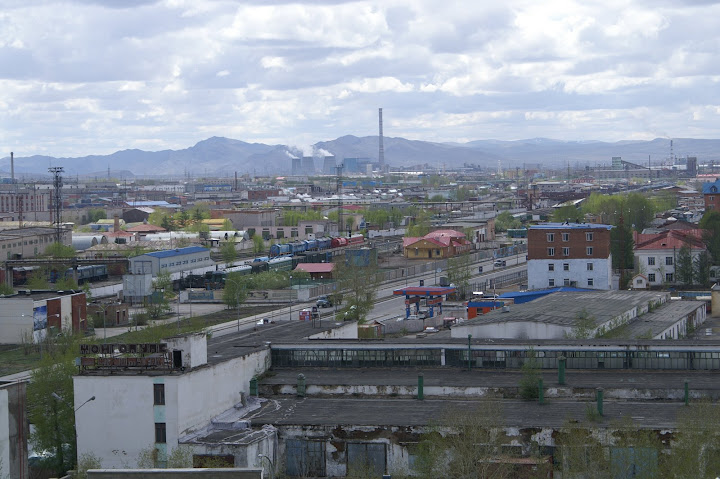 Mongolia used to be a communist country under the sphere of influence of Russia. It is also a cold country most of the time (warm people, cold weather). As a result, everywhere is centrally heated. I guess, due to its past, the heating of homes in Ulaanbaatar was done through big centralised boilers and hot water distribution systems. So, for example, your apartment does not have a water heater. Your building does not have a water heater. Somewhere nearby is a big boiler (if I can find one I will add a photo here I found the photo - it's above here). This big boiler supplies the hot water for the central heating to many of the buildings in the area. This is why EVERYBODY's Central Heating goes off on 15 May each year and why EVERYBODY's Central Heating comes on on 15 September each year, regardless of the temperature.This boiler also supplies the hot water for showers, washing and so on to the apartment.
Because it is so cold in winter, the Mongolians want to make sure that the boilers work for the full winter so they service them in the summer.
They are servicing the one that supplies my apartment building now - this is day number three without hot water. So whilst I would give a kingdom for a shower, it is not quite correct. I would give my kingdom for a hot shower :-((
At least I can feel moderately confident of feeling hot most of the winter.
Quote
A Shower, My Kingdom For A Shower
One of the things in short supply on the Steppe is water. There are a few rivers passing through, and if you are lucky, there may be a subterranean bore handy, all providing water. This water is generally carried by hand to the gers (round felt houses - like yurts) of the local population. In the Soums (small towns and villages) of Mongolia where there are no hotels or motels some accommodation can normally be found in the government buildings. In some of the more popular areas of Mongolia you will find tourist camps. Again, these may not have a large supply of water so cleaning facilities will usually consist of a bowl and some water (and very little water at that - and that supply only in a trickle). Being Australian, I like a shower. I like to be well cleaned. Going a few days without from necessity is not a great trial, but at the first available opportunity to take a shower, then a shower I will take.
Subscribe to:
Posts (Atom)